The art of massage
The Fundamentals – Three progressive levels of three days
For individuals, massage schools and spas
These courses are aimed at beginners wishing to acquire the right fundamentals of an effective practice, as well as at experienced practitioners and professionals wishing to deepen their practice.
THREE PROGRESSIVE LEVELS
FUNDAMENTAL 1: Knowing, Perceiving and Balancing the Myofascial System
Three days
The Art of Massage is designed as an essential component of a Manual Therapy of Well-Being, Health and Prevention.
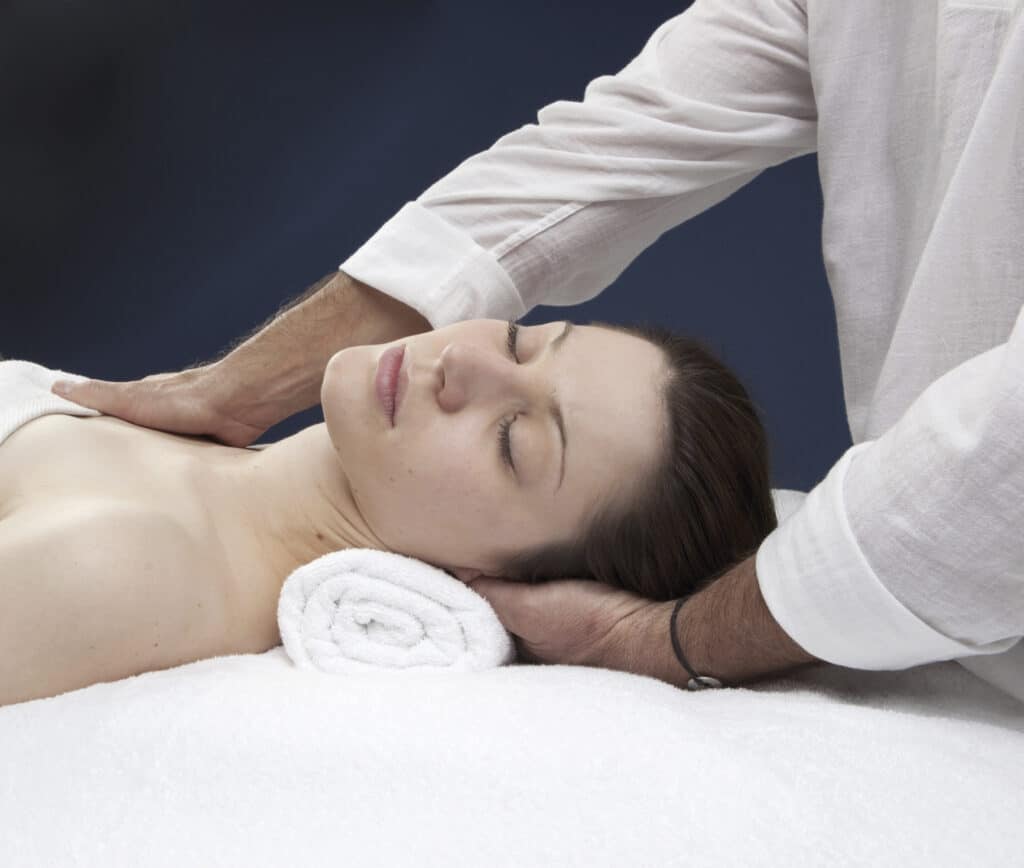
This first three-day level makes it possible to deliver, in one hour, a complete treatment that harmonizes and relaxes the muscles and fascia of the whole body, from the surface towards the depth.
The course covers:
– Establishing and conducting, from the very first contact and the preliminary assessment, the specific relationship that develops during a massage session, through to the final proposals for long-term support, according to the needs, wishes and possibilities of each receiver, for effective Prevention.
– Mastering rich, fluid and effective movements in terms of speed, depth, direction, power, sequencing and rhythm, perfectly adapted to the anatomy of the area being treated and to the individual specificity of each person’s tissues.
– The anatomical knowledge required for the areas treated (3D body study SOFTWARE).
– The elements of the practitioner’s psychocorporal practice: breathing, relaxation, grounding, perception, placement and movement of the Centre, all essential to integrate into the treatment so that it is both supple and harmonious for the receiver, and free of fatigue and of any risk of pain for the practitioner.
A course Certificate is awarded upon successful validation of the skills acquired during the Training.
FUNDAMENTAL 2: Knowing, Perceiving and Balancing the Deep Muscle Tissues and the Joints
Three days
Reaching the deep tissues and mobilizing the main joints of the body requires prior mastery of the Fundamental 1 practices.
The body is approached as a rhythmic, pulsating structure, centred on the dura mater and using the Sutherland fulcrum (the spheno-basilar joint) as its point of support.
The course covers:
– A review of the practices taught in Fundamental 1
– The anatomical and practical study of the deep muscular system
– The specific techniques for releasing and balancing the deep tissues
– The anatomical and practical study of the main joints, to be mobilized smoothly, without breaking the rhythm, in continuity with and in further development of the techniques used in Fundamental 1, within a one-hour treatment.
– Deepening the practitioner’s psychocorporal practice and learning to pass on a few basic practices useful to the receiver
A course Certificate is awarded upon successful validation of the skills acquired during the Training.
FUNDAMENTAL 3: Knowing, Perceiving and Balancing the Nervous and Energy Systems
Three days
Requires prior mastery of the Fundamental 1 and 2 practices.
Knowledge and perception of the reflex zones and points of the body, in synergy with the techniques previously acquired.
The course covers:
– Understanding how the central and peripheral Nervous System works
– Knowledge of the sympathetic, parasympathetic and autonomic nervous system, and of the notions of dermatome, myotome and viscerotome
– Understanding the energy principles of Chinese and Indian medicine
– The fine perception of the pathways, circuits, zones and most receptive points of the human body, in a way that is personalized for each individual
– Learning “in fine” to guide the receiver towards the perception of a “Still Point”, a space-time of calm awareness
– Learning to pass on to the receiver a simple practice enabling them to reach a space of awareness and regeneration independently.
A course Certificate is awarded upon successful validation of the skills acquired during the Training.
Maximum 10 participants